
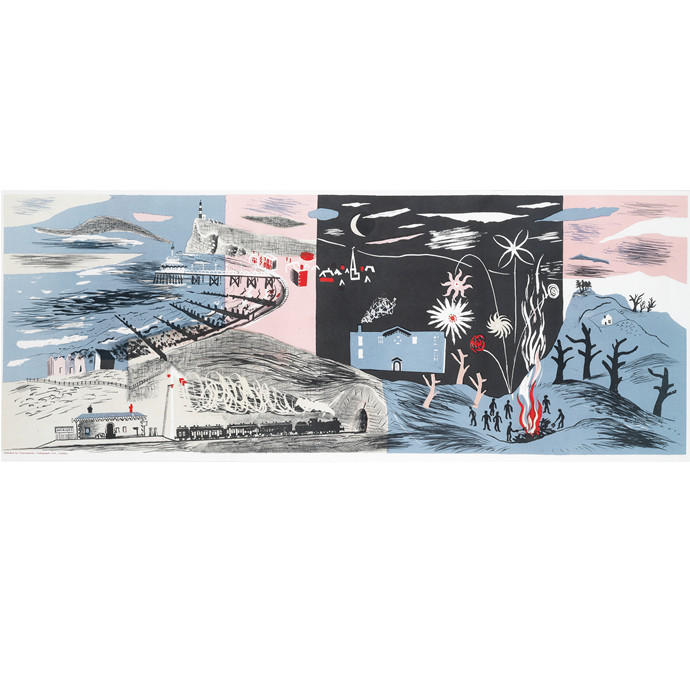
Piper, John: Nursery Frieze II – Landscape
£2,500.00
Taken from Hugh Fowler-Wrights’ invaluable exhibition companion, ‘Creative Partnerships’, 2011:
‘In 1936, John Piper set up Contemporary Lithographs Ltd with Robert Wellington to make original colour prints (auto-lithographs) of living Modern British artists cheapy available to schools and those on a low budget. He gathered many artists like Vanessa Bell, Graham Sutherland, Frances Hodgkins, Lynton Lamb, John Nash, Duncan Grant, Eric Ravilious and Ivon Hitchens into the scheme. Poor marketing and paper shortages stifled the commercial success of this venture yet it epitomises Piper’s lifelong desire to make good quality art at affordable prices’ (page 38).
Two long ‘Nursery Friezes’ were Piper’s contributions to the scheme, number I entitled ‘Seascape’ and number II entitled ‘Landscape’, We have available a lovely framed copy of ‘Landscape’ now 90 years’ old! These typically retail for in the region of £5,000 but with a child’s Christmas in mind, we’re offering the Frieze for only £2,500.
More images can be provided on request.
Artist: John Piper (1903 – 1992)
Title and date: Nursery Frieze II, Landscape, 1936/7, (Levinson 9)
Size: image: 49.5 x 125.2 cms.
Description
Artist Description:
Born in Epsom in 1903, John (Egerton Christmas) Piper, widely known as ‘JP’, studied at Richmond School of Art and the Royal College of Art from 1927-8 and in the mid-1930s. After a visit to Paris, he turned to abstraction, he became a member of the London Group in 1933 and a founder member of the ‘Seven and Five’ group in January 1934. During this period, he became friends with Oliver Simon of the Curwen Press and his interest in lithography and printmaking grew to become one of the main media in which he worked.
By the end of the 1930s, he had become disillusioned with abstraction and returned to a more naturalistic and representational approach. He concentrated on landscapes and architectural views in a distinctive style characterised as continuing the English Romantic or Neo-Romantic tradition.
During the Second World War, Piper was appointed as an official war artist recording the effects of the blitz on Britain’s buildings, especially churches. After the war, he became a Trustee of the Tate and National Galleries and in 1959 he became a member of the Royal Fine Art Commission.
A quintessentially English and 20th century artist, John Piper was endlessly innovative and extraordinarily prolific. He was dedicated to excellence and quality in all he did and there is hardly a medium in which he did not excel, including ceramics, fabric design, mosaics, murals, photography, stage sets and costume design, stained glass and even designing fireworks displays, he was also editor of the Shell Guide series for some 40 years.
He is best known for his extensive studies of British architecture, especially churches, and for landscapes in oil, watercolour and print. His work is often characterised by a bold use of colour, dynamic composition and an ability to capture the character of a place with a strong sense of atmosphere.
His work is avidly collected and is held in many museums and galleries but he was no establishment man, a position which may partly explain his ridiculously low profile in the art world. He loathed the Royal Academy and refused a knighthood in 1972 though he accepted a Companion of Honour for ‘distinction in arts’, something of an understatement. He died in 1992 just short of his 90th birthday.


